Description
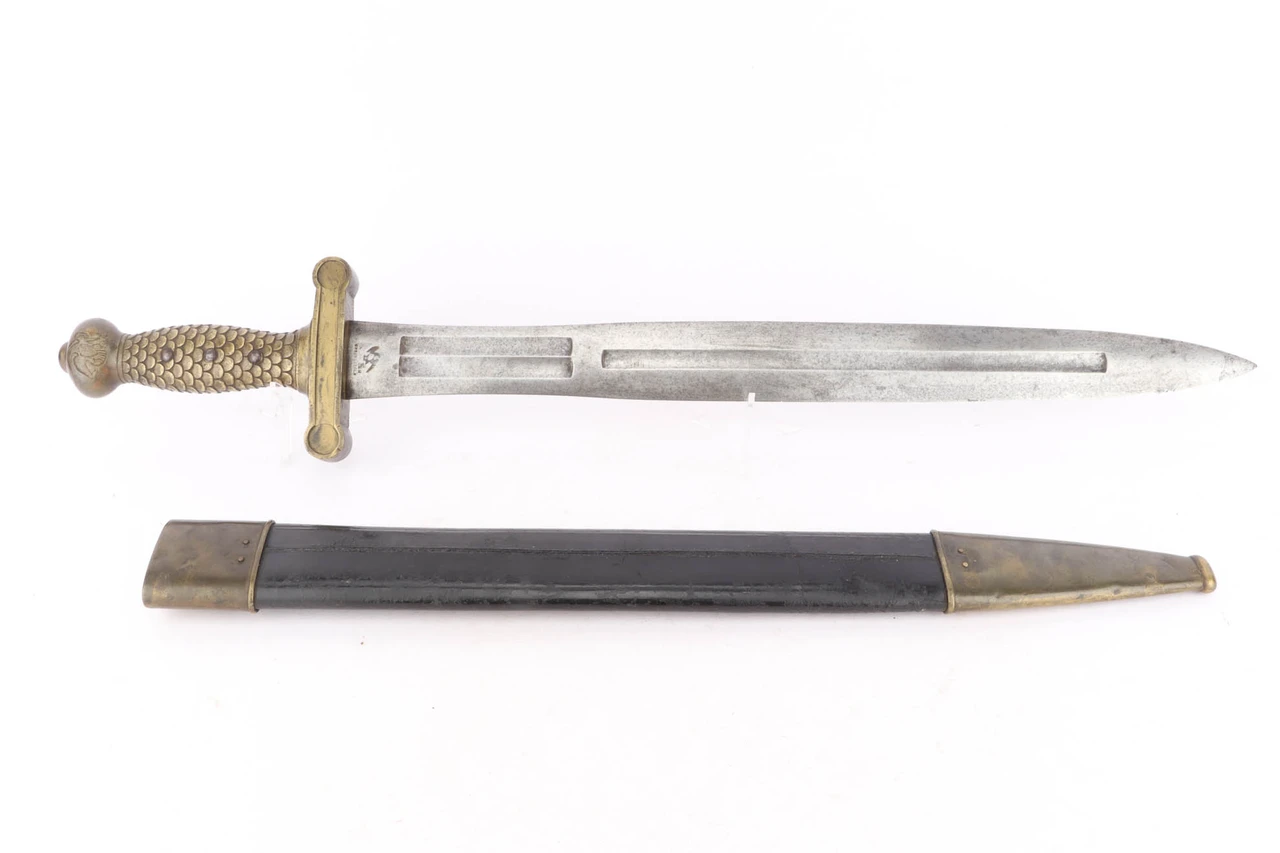
10/26/26 - This is a scarce, early-production U.S. Model 1832 Foot Artillery Short Sword, manufactured in 1834 by N.P. Ames of Springfield, Massachusetts, complete with its original black leather scabbard with brass fittings. Modeled after the French Model 1816 artillery sword, these feature the distinctive cast brass fish-scale grip, eagle-decorated pommel, and a straight, double-edged blade with broad fullers. The blade obverse shows the federal eagle and "N.P. AMES / SPRINGFIELD," while the reverse is marked with "UNITED STATES / 1834". Centrally located on the obverse at the top of the brass crossguard is the "S. HUSE / NEWBURYPORT" marking, along with inspection proofs stamped on both ends of the same area, identifying the early variation where hilts were subcontracted to Samuel Huse, Ames' brother-in-law, before Ames brought all manufacture in-house. These early Huse-hilt examples are particularly desirable and exceedingly rare. The sword remains in very good antique condition, with a pleasing, naturally aged brass patina, with areas of mild discoloration, and well-defined fish-scale detailing and eagle motifs. The blade is remarkably well preserved, showing a very light patina throughout, with areas of fine pinpricking and slight fading of the markings on both faces. There is one small nick along the right edge, but the blade otherwise retains its full original profile and appears never to have been sharpened. The original leather scabbard is complete with its brass fittings and is in great shape overall. The leather shows moderate surface crazing, areas of finish loss, and age-related wear, while the brass fittings are relatively clean, showing a areas of light patina, scattered handling marks, light dings, and dents. However, these are all minor and do not create any structural or fit issues. Scabbard fits perfectly.
The Model 1832 was adopted for American foot artillerymen and also saw use among infantry sergeants and musicians. Ames received his first government contract for 2,000 swords in June 1832, initially relying on Huse for the brass hilts and scabbard fittings. Manufacturing difficulties resulted in substantial government rejections of these early components, making surviving Huse-marked examples considerably scarcer than later Ames-produced swords. The pattern remained in service for decades, including through the Civil War, with approximately 20,100 swords ultimately supplied to the U.S. government under contract. This 1834-dated example represents an early and particularly collectible variation, retaining its original sword and scabbard configuration with the desirable Huse markings.