Description
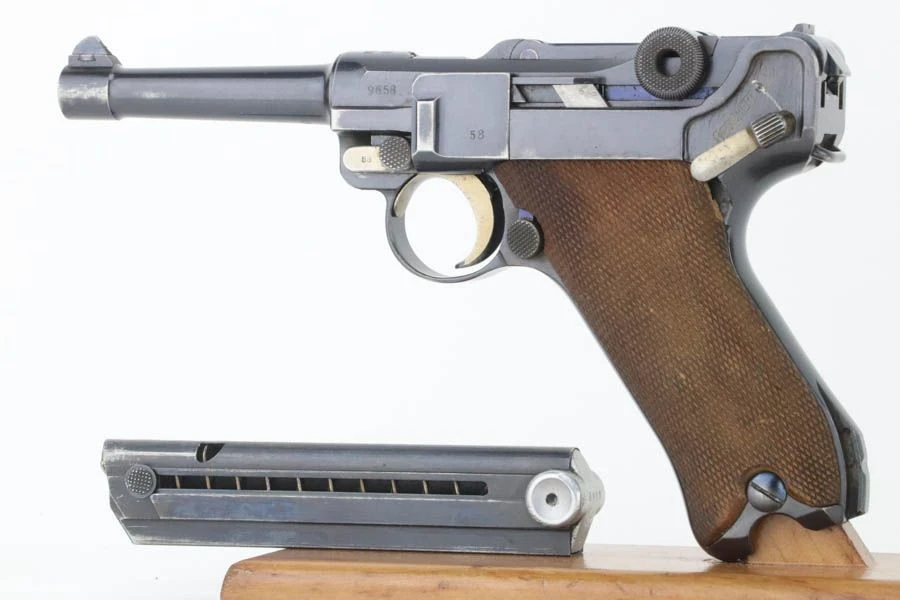
8/4/26 - This is a DWM Luger built in 1916 that started out as an military sidearm during WWI, and later stayed in legal German government inventory after the war. This is evidenced by the chamber, which carries what collectors call a double date. The lower 1916 is the year of manufacture, while the upper 1920 is a Weimar government property mark. After the Armistice, the Treaty of Versailles capped the German army at 100,000 men and tightly limited how many military arms the state could keep. Concurrently, the republic pressed civilian gun control to pull leftover war weapons out of private and paramilitary hands. These combined factors resulted in roughly five million firearms being collected or destroyed between about 1919 and 1921, while only a small Versailles legal stock, on the order of a few hundred thousand arms across all types, remained official issue. Guns that remained legal government property had to be accountable to the Inter-Allied Military Control Commission and easy to identify if stolen from a unit. In order to accomplish this, the Reichswehr ministry ordered small arms stamped 1920 so an official inventory piece could be differentiated at a glance from the mass of unmarked wartime arms still in circulation after Freikorps activity and depot disorder. The double date order ran from the fall of 1920 into early 1921, and subsequently any military pistol without the mark was considered illegal. Aside from the extra chamber date, this is the standard 4-inch 9mm Army configuration, DWM monogram on the toggle, GESICHERT safety legend, stock lug, and the usual right side Imperial military acceptance stamps with the Imperial eagle firing proof. This example is all matching and has retained about 93% of its bluing, with areas of mild finish loss on some of the high edges of the frame, on the slide rails, along the left side of barrel near the muzzle, and around the chamber where the barrel inserts. A few spots of wear on the sideplate, toggle contact lines, safety lever edges. Straw is mostly retained, though there is mild fading on the trigger and take-down lever. Fitted with its matching set of checkered walnut grips, which are excellent aside from a small chip in the left panel beneath the safety lever. Comes with one aluminum bottom, WWII-era numbered (mismatched) magazine. Bore is excellent, shiny with strong rifling.