
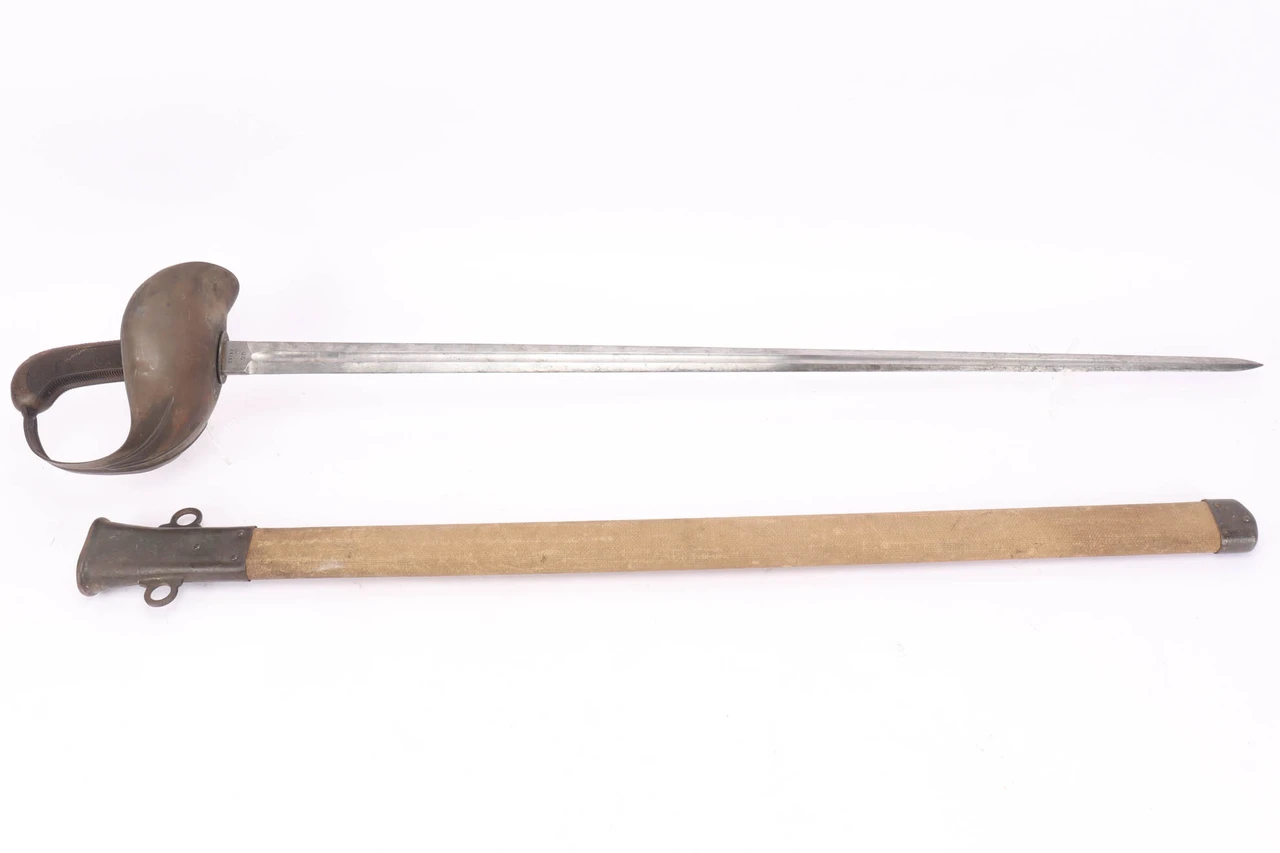


SOLD - Excellent, Early Springfield Armory M1913 U.S. Cavalry "Patton" Saber & Scabbard
| Year: | 1914 |
| Maker: | Springfield Armory |
| Type: | Model 1913 U.S. Cavalry Saber |
| Condition: | Excellent |
Description
10/19/26 - This is an excellent, second-year production Springfield Armory Model 1913 U.S. Cavalry Saber, also known as the Patton Saber, designed by Second Lieutenant (later General) George S. Patton Jr. This example dates to Springfield’s early production, before American entry into WWI and the later wartime contract with Landers, Frary & Clark (LF&C). These early examples (from the first two production years) are far more desirable due to lack of mass manufacturing techniques, It features a large steel basket hilt and a straight, double edged 35-in blade with a deep central fuller. This example is dated '1914' below the Springfield flaming bomb and is serial numbered '24313' beneath the US marking on the opposite side, identifying it as a second-year production example. Its profile is remarkably intact, with no signs of sharpening and only scattered, very minor edge nicks. Both faces show areas of mild scattered surface patina, with some slightly darker areas concentrated toward the tip. The original crosshatched grips retain well-defined checkering, with light handling wear, surface patina and some 'filling in' of a couple of the screws with what appears to be natural debris, though they don't look marred or distressed. However, we did not attempt to turn these grip screws to avoid any potential damage. The guard retains its perfect basket shape, though its surface shows patina, finish loss, and scuff marks. The original, canvas-covered scabbard is excellent, with sharply defined checkering and minimal handling marks, though there is some scattered staining and abrasion., with some light denting and distressing in the lower metal portion, but these are all minor. The steel fittings which bookend the scabbard are very good overall shape, though both show wear and surface patina. Some light denting/distressing in the lower fitting, but this does not impact function or form. The saber fits perfectly.
Influenced by his study with Adjutant M. Clery at the French Cavalry School at Saumur after the 1912 Olympics, Patton favored the point over the cutting edge for mounted combat. His design embodied this approach, which he developed in early Cavalry Journal articles, Saber Exercise 1914, and Diary of the Instructor in Swordsmanship. Officially a saber despite its uncurved blade, the Model 1913 replaced the curved Model 1906, a descendant of the Model 1860, and became the final standard combat saber adopted for U.S. cavalry. It represents a striking moment in military history: a weapon designed to perfect the mounted charge just as rifles, machine guns, artillery, and entrenched defenses were sharply limiting its usefulness. American cavalry still performed mounted duties during the war, but Patton’s greatest successes would come with armored formations in World War II, carrying his emphasis on speed, initiative, and aggressive attack into mechanized warfare.
Specifications
| Condition: | Excellent |
| Maker: | Springfield Armory |
| Year: | 1914 |
| Type: | Model 1913 U.S. Cavalry Saber |

